Experience Meets Wisdom
What I'm bringing with me into my second waterfowl season, and what I'm leaving in the last season.

First Steps
My entry into waterfowl hunting came from a half dangled offer, phrased like a wager and a dare. “You have waders. If you get a shotgun I will show you how to fold them birds.” That same night I was eagerly picking my mentor’s brain about the technical minutiae of identifying birds on the wing, the geometry of a good decoy spread, and where to position oneself to make sense of the chaotic ballet that happens once shooting light hits. He waved off my worry with the casual confidence of a man sitting in a laundry room strewn with gear, promising that once I felt the marsh come alive around me, it would all click. I did not need much, he assured me, just my walleye season waders and a shotgun plugged to “two plus one.” Three rounds, three shots, three dollars every time I emptied the gun into a passing flock.
We walked through chokes and the latest steel loads, debated the advantage or disadvantage of tungsten, and I left his place with a rendezvous point and a half dozen hand me down mallard decoys. I stopped at a sporting goods store, bought a box of steel for the next dawn, and spent the rest of the night sleeping like a kid on Christmas Eve, which is to say not at all.
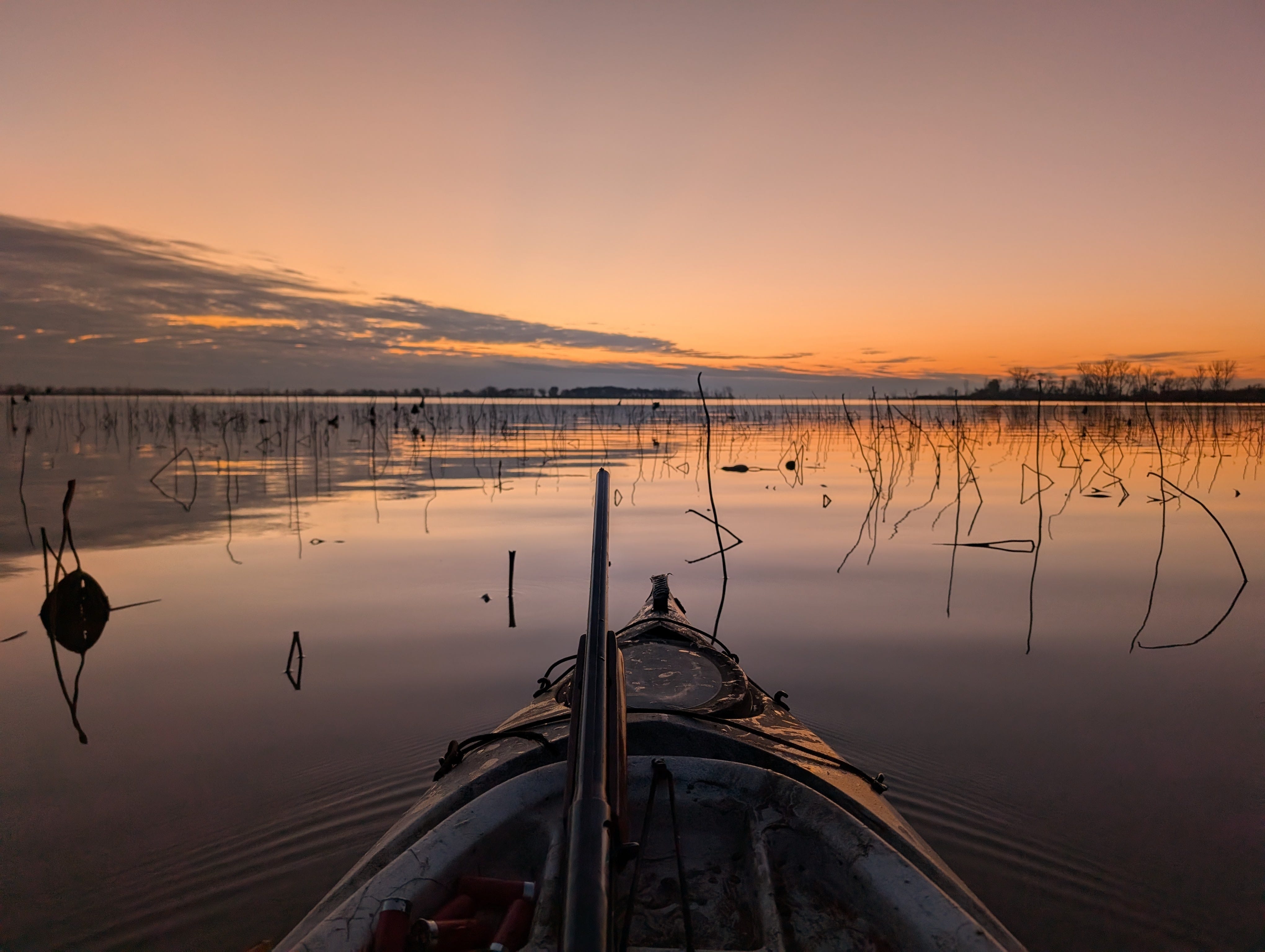
That lack of sleep and a long workday combined into a trifecta of missed alarms that left me racing toward the marsh at the exact moment shooting light broke. It felt like a humiliating rookie mistake. Not wanting to disrupt anyone else’s hunt and eager to join the thunderous chorus already rolling across the bay, I jumped into my waders and hauled myself to the first open pocket I could see. I tossed my modest spread of greenheads, tucked myself deep into the reeds, and waited for whatever might unfold.
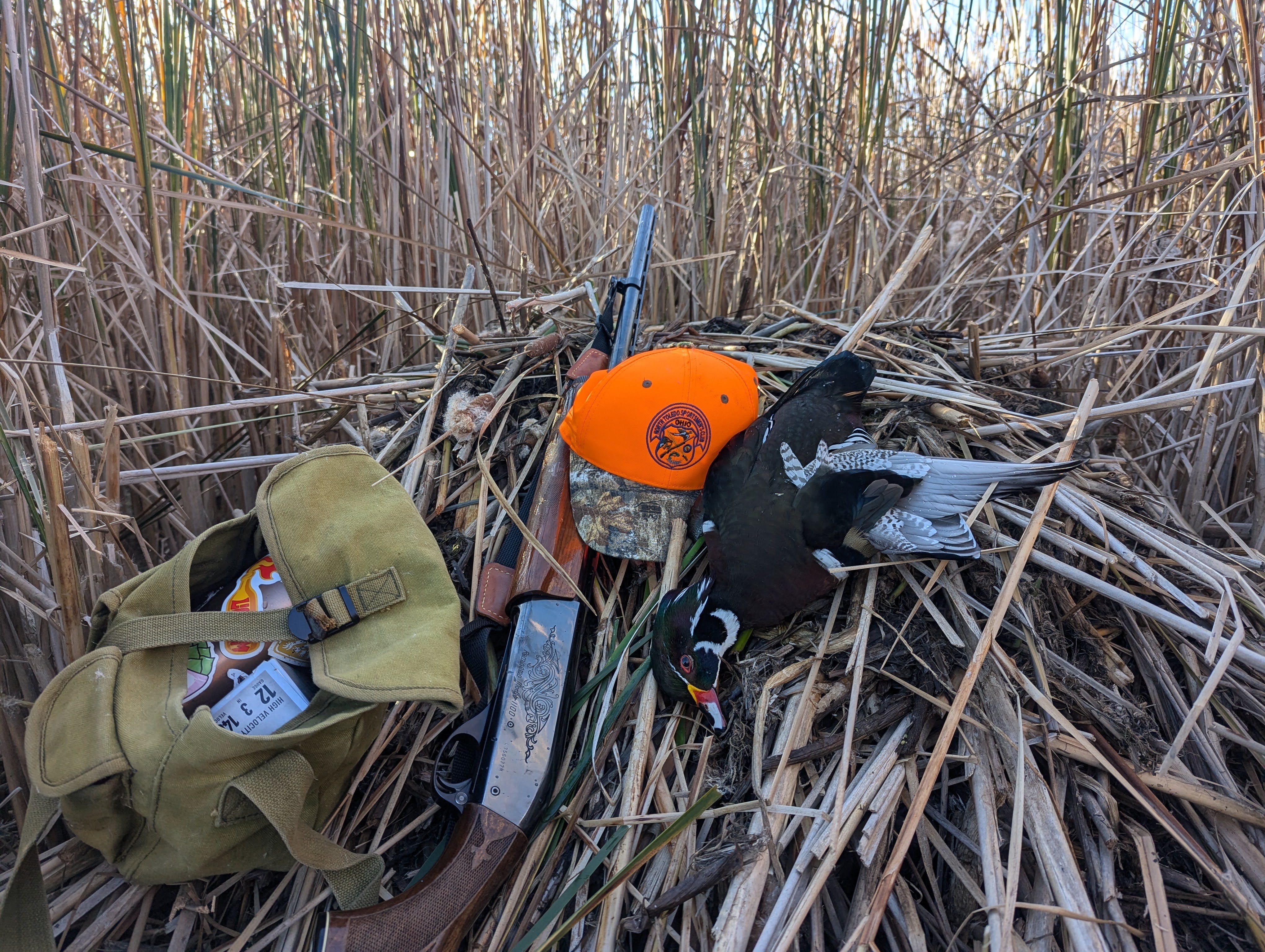
The stage was set for my first duck hunt. I was alone, standing in unfamiliar water, armed with an heirloom shotgun. A fixed full choke Damascus barrel married to a Remington 1100 receiver, the very same firearm that, with its slug barrel attached, I used to drop my first buck during the 2009 youth season. My grandfather, now ninety five, still remembers that morning, and I count it among the blessings of my life that we can still share those memories together.
Birds started sliding by almost immediately, each pass a little closer than the last. Wingtips whispered over my head with a sound I can still hear when I close my eyes, and my heart fluttered to match their wingbeats. Then two wood ducks drifted down toward my spread with a grace that felt unreal. I raised the bead to the drake’s head and paused, suspended in a moment that seemed to stretch. This was it. This was duck hunting. When they lifted off the water I fired, and within seconds I saw the drake flailing in the shallows, thick mud resisting every step I took toward him.
When I finally had him in my hands, the beauty of the bird hit me harder than the shot ever could have. I turned him in the strengthening light, studying the iridescence, the white accents on the face, the delicate scallops of the wings. Pride mingled with a deep, quiet grief. It was a beautiful creature, almost angelic in the morning sun, and I had ended its flight. I texted a photo to my mentor, somewhere deeper in the marsh behind me, and his reply—“beautiful bird”—let me exhale. Even now, well into my second season, the whistle of a wood duck can still send lightning down my spine.
Few things in the marsh rival their elegance. I doubt anyone will find that opinion controversial.
Key Season One Lessons
I spent much of my first season hunting alone. The thrill of carrying a small spread, slipping into tiny pockets, and coaxing down single birds or doubles into holes that only one hunter could use was intoxicating. That bottled lightning of my first duck kept me chasing day after day, assembling a surprisingly robust mental dataset of weather, pressure, location, and timing.
Most of my hunts took place in shallow bays and dense flooded cattails, with the occasional open pocket thrown in. Yet it was the handful of hunts with other waterfowlers—new hunters, lifelong hunters, old timers with a lifetime of stories—that taught me the most. The first and most universal lesson: make friends at the boat launch. Nothing ruins a morning faster than watching a couple of guys swamp themselves trying to race someone to a hole instead of pooling resources and covering an entire marsh more effectively. Some of my best hunts were the result of those simple conversations.
One of my favorites began with two old timers and their dog. After a quick chat in the lot, I offered to add my six greenheads to their spread if they would tolerate a novice in their blind. They agreed without hesitation. I learned more about calling that morning than in all the hunts I had done on my own, not through instruction but through quiet osmosis as I listened to their feeder calls dance across the water. I did not dare touch my own call for fear of botching a note.
Only when I returned home did I pick up my call and return to the beginning: one quack. A single, throaty quack to catch a bird’s attention. Then the soft, rhythmic tukatukatuka of the feeder call. Day after day I practiced until the notes stopped sounding forced. The payoff came early in my second season when I took a friend on her first duck hunt. Two groups worked our small spread in the mud, circling, committing, flaring mere yards from our faces. That moment alone justified every hour of practice. The old maxim remains undefeated: practice makes perfect.
Equipment carries its weight in the field as well. Many of my fishing tools—kayak, paddles, PFDs—proved indispensable when the cold pushed the puddle ducks south. They were not perfect solutions, but they got me eighty percent of the way there, and eighty percent is often enough to stay in the game. My twelve foot kayak was built for rivers and ponds, not the rolling chop of the bay, and certainly not the prone posture of a traditional layout boat. But it let me chase rafts of divers, jump shoot along cattail edges, and move with a freedom that made the hunt feel strangely ancestral. We are pursuit hunters at our core, shaped by movement, terrain, strategy, and cooperation. A good dog only amplifies that heritage, and after hunting over several, I can feel the future tugging me toward owning one of my own.
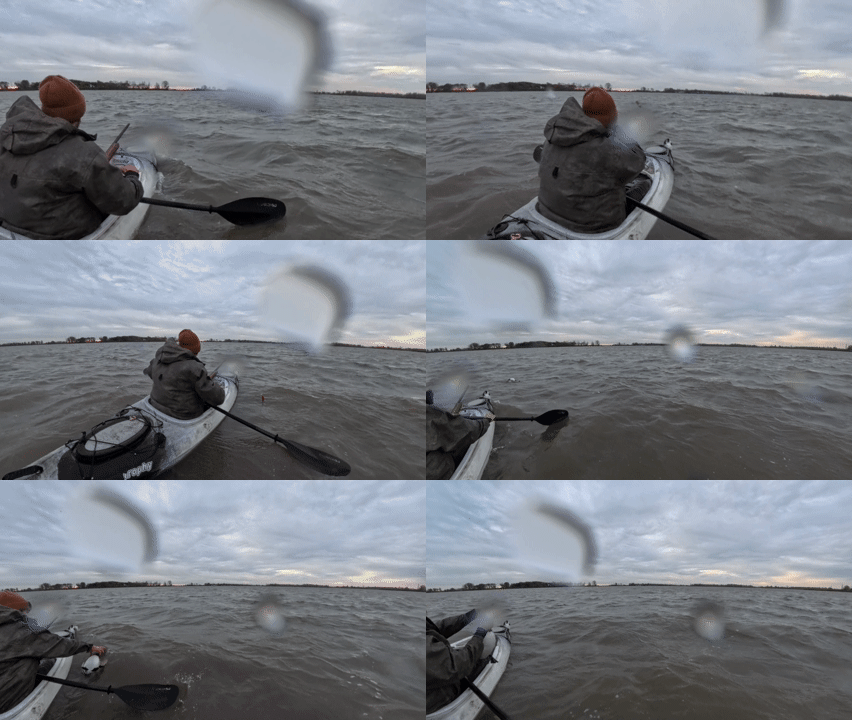
But for now, mobility remains my strength, and a true layout boat sits high on the list for the years ahead.
Season Two Wisdom
The further I get into this pursuit, the more the old saying proves itself: know your tools and their uses. Stepping outside my comfort zone has delivered some of my favorite memories, including my first spoonbill and canvasbacks. Neither hunt would have happened without the kayak, heavy raingear, and layer upon layer of wool beneath. Wool reigns supreme in winter, while cotton and linen keep you sane in the humid early season when mosquitoes reign.
I also find myself leaning toward carrying a twenty gauge in the seasons ahead. Modern ballistic technology has pushed the smaller bore far beyond its old limitations, making it fully capable for the birds and conditions I most often face. The lighter weight is a quiet blessing during long marches through cattails, and even if the ammunition is only fractionally cheaper, those slight margins accumulate across a season. It also has the virtue of being more approachable for newer or smaller framed hunters. Many of us carry a memory of a well meaning relative handing over a twelve gauge with the reassurance that it “does not kick too bad,” only for the first shot to nearly plant us in the dirt. A twenty gauge sidesteps that rite of passage without sacrificing effectiveness. It fits neatly into my broader effort to stack one or two percent improvements wherever I can, a shift toward practicality without losing the heritage of my grandfather’s old twelve, which will always remain a treasured part of my hunting lineage.
Paying attention to the color palette of the landscape matters more than I realized at the outset. Much of the water I hunt in late season wears a grayscale cloak of brown, amber, slate, and cloud shadow. My grey rain suit, brown hat, and mottled kayak almost vanish in a light drizzle. With a bit of off season tinkering I should be able to adapt the same craft for shallow marshes with a brushed in blind. I also plan to practice shooting from awkward positions, because ducks have a talent for appearing from the least convenient angle at the least convenient time.
There is no substitute for time in the field. E scouting is an incredible tool, but satellite images cannot capture the sound, smell, and subtlety of a marsh at dawn. They will not tell you which pocket is wind sheltered, which channel boasts submerged logs, or which flooded corner becomes a mallard expressway after the first freeze. I have found some of my favorite spots simply by noticing a patch of DNR land on my drive home and deciding to stretch my legs.
Closing Thoughts
Waterfowl hunting continues to reshape my understanding of patience, humility, and responsibility. Each season brings a deeper respect for the birds themselves and for the ancient lineage of pursuit we step into when we shoulder a shotgun in the marsh. My first duck still sits in its jar of bottled lightning, a reminder that awe and grief can coexist, and that reverence is not the enemy of the hunt but the thing that dignifies it.
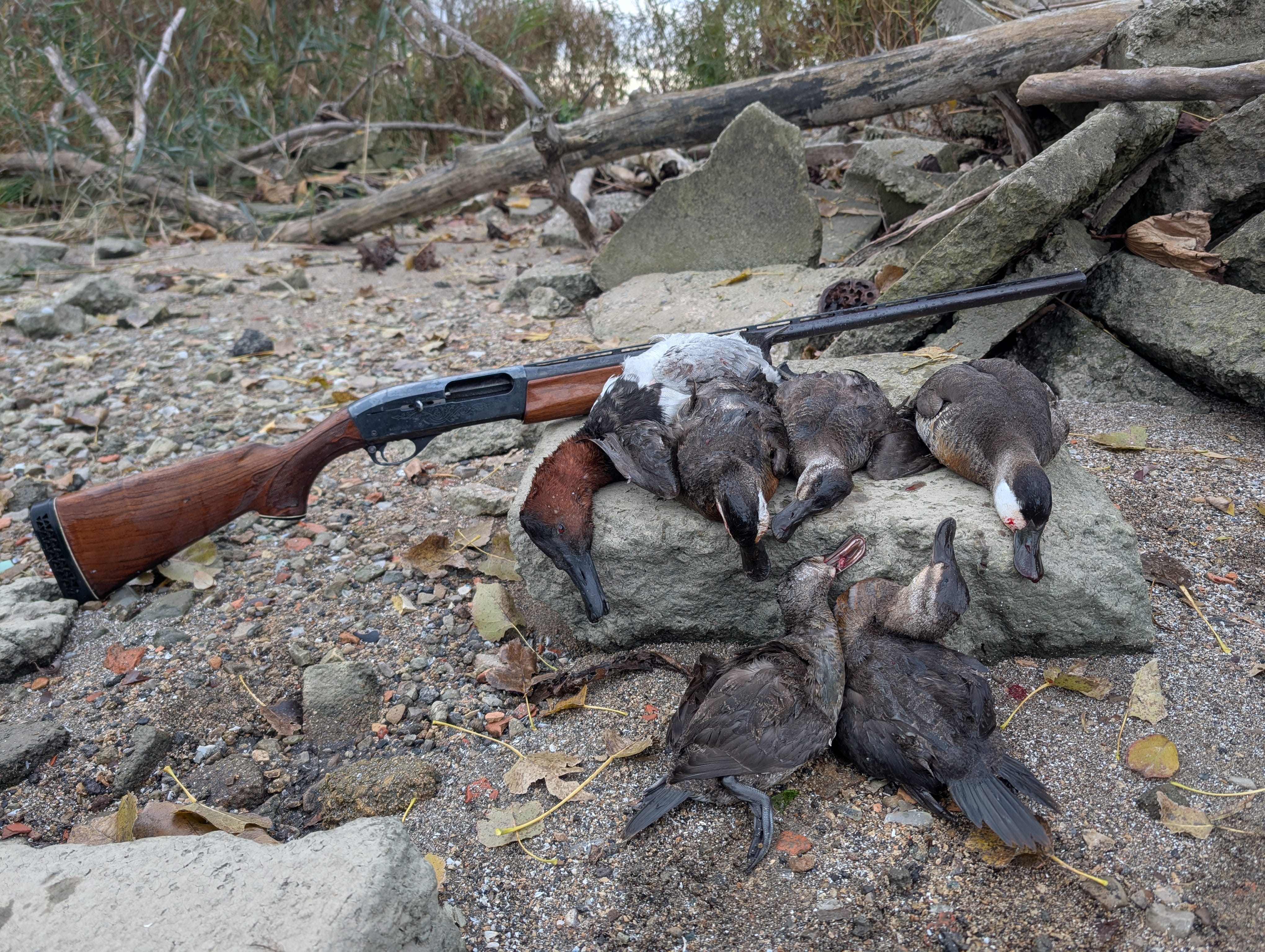
Season two is still young, and I feel the same anticipation that carried me into the marsh on my first morning. There are new tools to try, new waters to explore, new birds to encounter, and new lessons to gather. If the past two years have taught me anything, it is that the pursuit itself is the point. The marsh is a teacher with no end to its curriculum.
And I am still listening.
Inspiring. I got off to a decent start living on Lake Champlain in Vermont. But a few years ago I moved to the mountains of Maine. Here, jump shooting is your best bet, as ducks are only here and there and no where too dependably. Maine coastal areas are excellent and I hope to connect with some folks and get back into it. Have the time and the gear, but caught up in too many kinds of hunting here at the moment.
Keep up the good work. I enjoy the writing.